[#item_full_content] [[{“value”:”by Amos Bloomberg
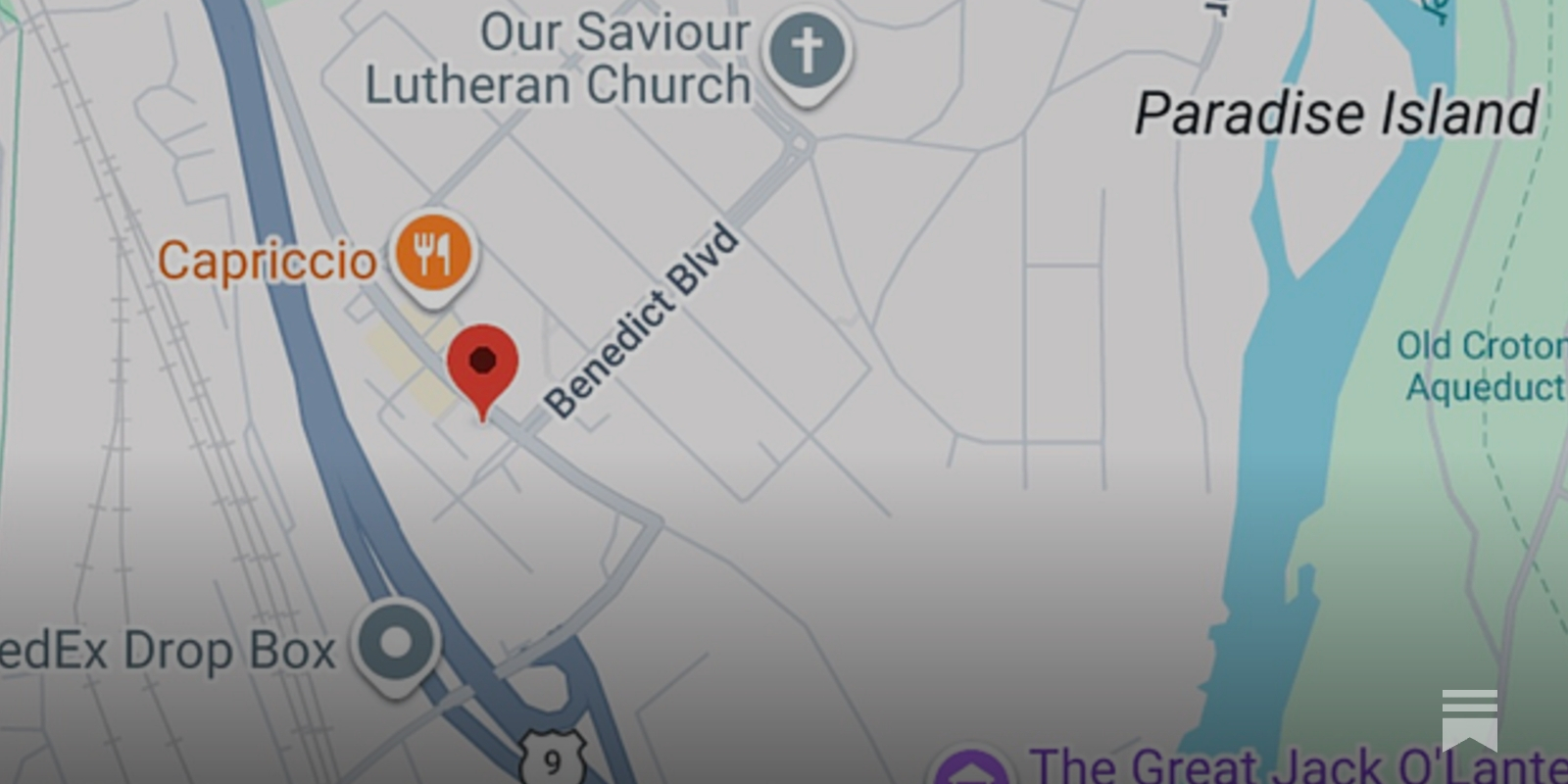
370 South Riverside Avenue, Croton-on-Hudson (red marker)
Dear Planning Board,
I write this long and detailed letter to share some research I have done and to argue for your denial of the pending change of use application for 370 South Riverside Avenue, which seeks to establish a cannabis dispensary at the corner of South Riverside Avenue and Benedict Boulevard. I will lay out clear reasons why this proposed use is fundamentally inconsistent with the Village’s Comprehensive Plan, its Gateway zoning, incompatible with local laws and policing. The documented history of traffic, parking, and safety concerns at this specific intersection, the contradictions with the Bicycle & Pedestrian Master Plan adopted by the Village, and the pre-existing concerns over the Village’s ballooning police burden only compound the reasons to deny this use.
I. The Proposed Use Is Contrary to the Comprehensive Plan’s Vision for Neighborhood-Serving Retail
The Comprehensive Plan’s Village-Wide Recommendations (Section 4.2) require the Village to “preserve the historic character of Croton-on-Hudson,” identifying its “history and small town character” as “central to its distinctive charm.” The Plan further identifies “a need for new stores in existing commercial areas meeting neighborhood shopping needs.”
The commercial districts along South Riverside Avenue were rezoned for mixed use based on the findings of two studies — by Saccardi & Schiff and by Danth, Inc. — both of which focused on neighborhood-centric retail. Their aim was to diversify the area away from auto-related businesses They explicitly acknowledged that tax revenue, while important, was not the sole consideration for businesses allowed to operate in the zone. The kinds of specialty retail the Plan explicitly envisions — shops including Wondrous Things, the Book Hut, and the Cornelia Cotton Gallery, and small cafes and restaurants — are of a completely different nature than a cannabis dispensary.
Section 3.8 (Special Planning Areas) states that “the customer base for each of these commercial centers is primarily local, drawing shoppers from within the Village and Northern Ossining, rather than from the Northern Westchester region,” and that “Croton-on-Hudson has made an effort to […] maintain the local orientation of these districts.” The Plan further specifies that these commercial centers “play a dual role in the Village, as sources of retail and services for residents and as defining ‘images’ of certain areas of the Village.”
A cannabis dispensary at this location would not serve an unmet local need. Croton residents already have access to dispensaries in nearby Ossining. Lucky Leaf Dispensary and Up The River Cannabis Dispensary are both within two miles driving distance from the proposed location. However, there is a large area of approximately 50–60 square miles directly to the north and east of Croton — stretching to Peekskill (about 7 miles north) and Mount Kisco (about 12 miles east) — with no dispensary at all. This area, which currently lacks a dispensary, is precisely the “Northern Westchester region” from which the Comprehensive Plan explicitly seeks to avoid drawing customers. Reporting by Westchester Magazine finds that “legal dispensaries tend to attract clientele from neighboring towns” due to the lack of dispensaries in much if Westchester. Croton residents fortunately already have dispensaries nearby. A dispensary at 370 South Riverside would function as a regional draw, not a neighborhood store — the opposite of what the Comprehensive Plan indicated.
As Trustee Simon observed at the Board of Trustees meeting on December 6, 2021, the likelihood of Croton attracting a dispensary vendor is itself an indication that vendors “will most likely go where the greatest populations are” — that is, where a regional customer base exists, not where local need dictates. He was right – we are very near a large potential customer base. Serving this large population outside our village to our north-east currently undeserved by cannabis retail is contrary to Village planning.
II. The Proposed Use Undermines the Purpose of the South Riverside Gateway Overlay District
370 South Riverside Avenue sits at the entrance of the South Riverside Gateway Overlay District. The Comprehensive Plan describes this district as “an important image-defining gateway to the Village due to its strategic location on Route 9A and its accessibility to the railroad station, Route 9 and Croton Point.” The Plan states that “gateways mark a sense of arrival, and connection to a community, and establish an image for the community.” The primary purposes of the Gateway designation include “upgrading the image and function of commercial areas, defining the entry into the Village, strengthening the overall visual identity of the Village, and improving linkages to adjacent residential neighborhoods.”
A cannabis dispensary as the first visible retail business on the first major retail commercial intersection upon entering the Village from the south sets entirely the wrong image. The Gateway Overlay District was created specifically to define the community’s visual and commercial identity at its most prominent entry points. Allowing a dispensary to occupy this position contradicts the stated intention of the district. Take a look at dispensaries in the surrounding towns and you will see that they are usually indications of commercial decline.
The Village has recognized its authority to restrict uses that are inconsistent with community character in gateway and commercial areas. The Local Law Filing regulating Adult Entertainment businesses, passed July 11, 1994, was grounded in findings that certain business uses in “inappropriate locations” are inconsistent with existing or future development plans, that they “increase the crime rate and undermine the economic, moral, and social welfare of the community,” that they “adversely affect existing businesses and community and family life,” and that “of particular concern is the location of these uses in areas where our youth may regularly assemble.” The law further warned that as “business activity drops off and the quality of life deteriorates, merchants and families move away from the area, leaving it in a vacant and depressed state.” These findings, which supported the restriction of one category of disfavored business, apply with equal force to the present application.
While many in our community may support the opening of such a business within the village. I believe it is clear that, just as with other controversial businesses, a Gateway zone is not the appropriate location.
III. The Proposed Use Conflicts with the Village’s Commitment to Protecting Youth and Families
The Village has repeatedly demonstrated its concern for protecting young people and families from the potential harms of cannabis. At the Board of Trustees meeting on March 15, 2021, a Trustee stated that cannabis packaging and marketing gives the impression that “the entire industry is targeting children.” At the December 6, 2021 meeting, Laurie Dean of the Croton Community Coalition presented evidence that every state with dispensaries has seen increased emergency room visits by children who have ingested cannabis products. Trustee Horowitz stated at that same meeting that “as parents our first impulse is to protect our children” and questioned why the community had not been more broadly consulted.
The Village acted on these concerns. On June 21, 2021, the Board of Trustees adopted Resolution #107 of 2021 to prohibit the smoking of cannabis in Village-owned parks and recreation areas, subsequently amended on July 19, 2021 by Local Law Introductory No. 10 of 2021. Further, through Resolution #152 of 2021, the Village Board voted to opt out entirely of allowing on-site cannabis consumption establishments, citing the burden such establishments would place on the Police Department.
The Comprehensive Plan itself, in Section 3, stresses that “the Village must provide the services and quality of life that will attract and retain the new Village immigrants and younger workforce needed to replace a labor force that is shrinking as the population ages.” Establishing a cannabis dispensary — selling a product whose effects on children have been a documented concern of this Village’s elected officials and residents — is inconsistent with the goal of creating a safe and welcoming environment for families with young children. I would make the same argument if a liquor or smoke shop were proposed at this location.
IV. The Location Already Suffers from Severe Traffic, Parking, and Pedestrian Safety Deficiencies
The intersection of South Riverside Avenue and Benedict Boulevard has been the subject of continuous concern from the Bicycle and Pedestrian Committee (BPC), the Police Department, and the community for years:
– The BPC (of which I was a member for seven years) was itself born of a dangerous incident at this location. Its founder, Josh Moreinis, organized the group after he was nearly struck by a car while walking home from work on this stretch of road. The dangers of the intersections and roads in this area has since been a neverending topic at meetings and has been flagged incessantly by the Bicycle-Pedestrian Committee, e.g.
– On February 26, 2019, the BPC met with Police Chief Russ Harper to discuss intersections requiring attention for visibility and safety, specifically including South Riverside at Benedict and Oneida.
– Again on January 18, 2023, a BPC member raised a specific concern over the visibility at intersections along this stretch of South Riverside and that traffic coming down Riverside on this stretch was dangerous.
– On February 20, 2025, the BPC revisited this “long standing proposal” to mitigate repeated reports of dangerous vehicular traffic on this stretch of road.
– On May 21, 2019, the BPC noted the safety challenge to pedestrians and cyclists in this exact area in their recommendedation that the Village invest in bike posts at the corner of Benedict and Riverside to prepare for new development.
– In May 2021, the BPC documented the significant sidewalk gap on South Riverside Avenue from the Sunoco station to the intersection with Oneida Avenue as a priority for remediation due to its dangers to pedestrians, often children, on the West side of Riverside who have to cross the busy road mid-block to reach a sidewalk.
– BPC members over the years have reported that morning and evening vehicle traffic in this area is “rabid,” forcing cyclists to ride on sidewalks for safety due to “dozens of near misses.” These are just a few choice quotes from dozens of concerns in documented BPC meeting notes.
The proposed dispensary location has only four parking spaces available for commercial use; the remaining spaces are designated for building residents. Parking on Benedict Boulevard was only in recent years brought under permit regulation precisely because non-residents were using it as overflow parking for businesses and the train station — evidence of a pre-existing parking deficit. A dispensary drawing customers from a regional catchment area of 50–60 square miles will inevitably worsen an already dangerous situation and further erode parking and safety for residents of the area.
The Comprehensive Plan itself, in Section 4.2, calls on the Village to “improve traffic flow and parking,” noting that “traffic congestion is cited frequently as a problem, particularly in commercial areas,” and that “addressing these issues is seen as important both for the success of retail and other businesses, and for pedestrian safety.”
V. The Village’s Own Police Resources Cannot Absorb the Additional Burden
The Board of Trustees opted out of on-site cannabis consumption establishments through Resolution #152 of 2021 in part because officials expressed concern that such businesses would “add one more type of impairment that our Police Department would have to deal with,” and because technology does not yet exist to allow officers to reliably determine marijuana impairment during traffic stops. The Governor’s office has since shifted policing focus from possession to impairment, placing the operational burden squarely on local departments. NY State Police have publicly reported a 20% increase in DWI arrrests due to cannabis since legalization.
The Village’s police force is already resource-constrained. As far back as June 1, 2020, the Board of Trustees discussed whether maintaining a 21-officer force was sustainable. The Police Advisory Committee’s year-end report for 2025 stated that the PAC “had in depth discussions with Chief Nikitopoulos about staffing levels” and “recommended to the board that the Village hire additional officers” to maintain current levels of service, along with a recommendation to “hire a police department consultant to determine best practices and staffing levels.” In early 2026, the Board of Trustees planned a comprehensive examination of the Police Department’s operations in light of a $20 million budget in which the cost of equipment has “doubled in the last five years.” On May 21, 2025, the Board adopted Resolution #125 of 2025 requesting state authority for red-light cameras — an explicit acknowledgment that constant physical police presence in high-traffic areas is too difficult or too costly to maintain for the Village.
Introducing a cannabis dispensary into a highly residential area with documented traffic safety hazards surrounded by a residential district primarily made of many families with young children concerned for their safety will inevitably require increased policing that the Village is not in a position to provide.
Conclusion
The application before the Board asks it to approve a use that is contrary to the Comprehensive Plan’s vision for neighborhood-serving retail, that undermines the image-defining purpose of the South Riverside Gateway Overlay District, that conflicts with the Village’s commitment to protecting youth and families, that will further erode documented traffic and pedestrian safety hazards at one of the most dangerous intersections in the Village, and that will impose burdens on an already overstretched police force.
As Planning Board precedent shows, incompatibility with the Village’s Comprehensive Plan and stated zoning policies is unrelated to the nature of a given business. There is direct precedent from this Board for denying a change of use on similar grounds to those I have outlined above for adult entertainment, daycares, late night clubs, and doggy day cares. I fully agree with Mayor Pugh, who on the December 6, 2021 meeting on dispensaries said that people will consume cannabis whether or not it is legal or available for sale in the village. However, I hope I have made clear that the presence of this type of business at this important location runs contrary to the village’s stated policies and plans.
I respectfully urge the Board to deny this application.
Regards,
Amos Bloomberg
Amos Bloomberg, 50, grew up in Croton-on-Hudson in the 1980s and early 1990s—a time when Croton residents readily drove to Ossining for their cannabis needs. Amos works as Clinical Professor of Computer Science at New York University, where he focuses on software engineering and education automation. He writes here in his personal capacity.
***********************************************************************************************************
Editor’s Note: The Chronicle strives to give voice to the widest possible diversity of viewpoints in our community. To discuss a submission, please get in touch at TheCrotonChronicle@gmail.com
********************************************************************************************************
Subscribe
To share this post, or to share The Croton Chronicle, please click on these links.
Share
Share The Croton Chronicle
Comments policy: No personal attacks or trolling. Please be polite and respectful at all times.
Leave a comment”}]]  Read More
A letter to the Croton Planning Board opposing approval of a cannabis dispensary in the village.

ByPot Shop News
April 7, 2026